Knowledge base / Care and gear
Taping Socks, Gloves and the Rest of Your Hockey Gear
Short answer
Use stretchy polyethylene shin pad tape on socks and pads, in clear or a colour that matches your socks. Use cloth or grip tape only on the stick. Smooth tape at the top of the stick can save your glove palms. Do not tape over a helmet's certification sticker, and do not tape a mouthguard.
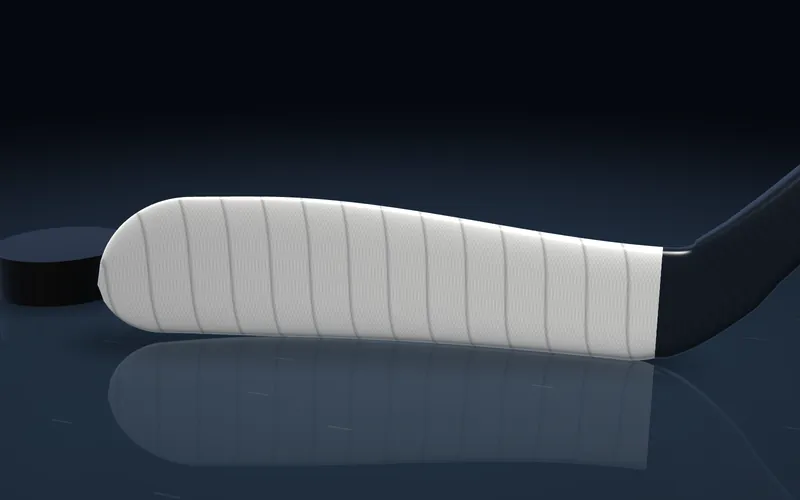
Your stick is not the only thing that gets taped. Socks, pads and the top of the stick where your glove sits all have their own tape. Here is what to use where, and what to leave alone.
Socks and shin pads
Shin pad tape, also sold as sock tape, holds your pads and socks in place. It is stretchy polyethylene, not cloth.
- Renfrew Pro says it made the first polyethylene shin pad tape, in 1985. Its Polyflex line is moisture resistant, tears by hand and has elasticity and memory.
- Howies says its clear tape conforms to your pad and leg and stretches with your muscles.
For how to wrap pads, see clear tape or sock tape for shin pads.
Sock tape colours
Clear and coloured tape do the same job. The difference is the look. Renfrew Pro’s catalogue lists Polyflex in clear, black, white, red, orange, yellow, green and royal blue.
How to pick:
- Clear disappears on any sock and is the safe choice if your team changes jerseys.
- Matching a colour to the sock stripe makes the tape blend in.
- Team colour is a tradition in minor hockey, where a team often agrees on one colour. That is our observation, not a documented rule. Check whether your league or team has a preference before you buy a case.
Team colours show up on sticks too. A Steve Yzerman game-used stick from Detroit’s late-1990s Cup years has red cloth tape over white on the handle. A 2024-25 PWHL stick used by Ottawa’s Jessica Adolfsson has a long red handle in the Charge’s colour.
Gloves
Your top hand rubs the knob and handle all game. Rough cloth tape can wear through glove palms.
New Jersey’s Dawson Mercer uses smooth electrical tape at the top of his stick for that reason. He told NJD.tv in 2022 that ordinary hockey tape tore his gloves on the outside of the palms, and that 51 games into the season he was still using the pair he started with. The Devils’ equipment staff found him a close match from 3M.
If you want to try it:
- Smooth tape gives less grip than cloth or grip tape. Build a slightly bigger knob if the stick slides in your hand.
- Keep cloth or grip tape where you need grip, and smooth tape only where your palm wears.
- Goalies: NHL and IIHF rules still require a white knob. See goalie stick knob rules.
Tape inside or on a glove is a different matter. We could not find any glove maker’s guidance on taping a torn palm, so we do not recommend it as a repair. A glove with a hole in the palm needs a repair shop or a new pair.
Helmets and cages
Leave the helmet alone. A 2010 CSA letter published by Hockey Canada’s safety program says almost every hockey helmet sold in Canada carries three certification stickers, and that the CSA sticker is the one to check for play under Hockey Canada. Do not cover it with tape, decals or anything else. If a helmet or cage is cracked or bent, replace it rather than taping it.
Mouthguards
Do not tape a mouthguard. We could not find any mouthguard maker or governing body that supports it. If the strap or tether breaks, replace the mouthguard.
Other handles
Grip tape is not only for sticks. Renfrew Pro says its StretchRap is for custom grips on hockey sticks and other sport equipment handles. Its foam under-wrap can double as a headband or hold an ice pack in place.
Carolina’s equipment manager described one extreme: Dylan Coghlan put fibreglass in his handle, then wrapped it with gauze and grip tape until the top of the stick was round.
The stick itself
Tape is not a repair for a broken stick. Blade Tech Hockey says minor chips and scratches can be sealed with clear fibreglass tape to keep moisture out, but cracks are structural. A cracked stick needs professional repair, and even then Blade Tech says to treat it as a practice stick. Most of the time, replace it.
Which tape for which job
| Job | Tape | Why |
|---|---|---|
| Blade | Cloth | Grip on the puck, protects the blade |
| Handle and knob | Cloth or grip | Grip for your hands |
| Top of stick, if gloves wear out | Smooth tape (electrical, as Mercer uses) | Less wear on glove palms |
| Socks and shin pads | Polyethylene shin pad tape | Stretches with your leg |
| Equipment handles | Grip tape | Custom grip |
For the full comparison, see cloth vs grip vs clear vs sock tape.
Safety note
Never wrap tape on bare skin so tight that it pinches, tingles or leaves a foot cold. Cut tape off with blunt-tipped scissors, blade pointed away from your leg.
Sources
- Renfrew Pro product catalogue (Renfrew Pro) renfrewpro.com
- Hockey Shin Pad, Shin Guard and Sock Tape (Renfrew Pro) renfrewpro.com
- Clear Shin Pad Hockey Tape (Howies Hockey Tape) howieshockeytape.com
- A Different Grip | Three Things (NJD.tv, Feb. 2022) nhl.com
- Steve Yzerman's late 1990s Detroit Red Wings game-used stick (Classic Auctions) classicauctions.net
- 2024-25 PWHL Ottawa Charge game-used Jessica Adolfsson stick (The Realest) therealest.com
- Hockey helmet certification stickers (Hockey Canada / CSA, June 2010) cdn.hockeycanada.ca
- Can you fix a broken stick? (Blade Tech Hockey) bladetechhockey.com
- Mailbag #69: Equipment talk (Hurricanes.com, Oct. 2023) nhl.com